Introduction: Forex Trading Explained with Examples
Forex trading is the act of buying one currency and selling another with the goal of making a profit. Traders do this in the foreign exchange market (Forex or FX) — the largest financial market in the world, where more than $6 trillion moves every single day.
If this sounds complex, don’t worry — this guide will simplify everything. Here, you’ll find forex trading explained with examples so beginners can understand how the FX market works step by step.
You will learn:
- ✓ What forex actually is
- ✓ How traders make money
- ✓ How currency pairs work
- ✓ What pips, lot size, spread, and leverage mean
- ✓ How to start trading forex safely
- ✓ The best time to trade
- ✓ The common beginner mistakes to avoid
By the end, you’ll understand the foundation of one of the most exciting and accessible financial markets in the world.
1. What is Forex Trading? (Simple Definition for Beginners)
Forex, short for Foreign Exchange, is a global marketplace where currencies are bought and sold. When you trade forex, you’re predicting whether one currency will strengthen or weaken against another.
Example:
- ✓ If you BUY EUR/USD, you think Euro will rise and Dollar will fall.
- ✓ If you SELL EUR/USD, you think Euro will fall and Dollar will rise.
Why forex trading exists:
- ✓ Countries import and export goods
- ✓ Travelers exchange currency
- ✓ Banks and businesses move money internationally
- ✓ Companies hedge risks
- ✓ Investors and traders speculate
This simple definition builds your foundation for learning how to start forex trading for beginners.
2. How Does Forex Trading Actually Work?
Forex trading always happens in pairs because you buy one currency while selling another.
Example:
EUR/USD = Euro vs US Dollar
If EUR/USD rises, it means the Euro is getting stronger relative to the Dollar.
Forex prices move because of:
- ✓ Economic news
- ✓ Interest rate decisions
- ✓ Inflation
- ✓ Government policies
- ✓ Wars or global events
- ✓ Market psychology
- ✓ Institutional trading (banks & hedge funds)
These movements create profit opportunities — and that’s what traders try to predict.
3. Why Forex is So Popular Among Beginners
Here’s why millions of people learn forex every year:
- ✓ Low starting capital — Start with as little as $50–$200 because of leverage.
- ✓ Open 24 hours a day — Trade morning, afternoon, or late night.
- ✓ High liquidity — Orders execute quickly with tight spreads.
- ✓ Easy access — Just a phone or laptop + trading app.
- ✓ Clear patterns — Price action, trends, ICT concepts all work well.
- ✓ Works with small accounts — Slow, safe, steady growth possible.
Compared to stocks or crypto, learning how to start forex trading for beginners often feels easier because the rules are simple and price follows logical patterns.
4. What Are Currency Pairs? (Base & Quote Explained)
A currency pair shows the price of one currency relative to another.
Example:
EUR/USD = 1.1050
This means 1 Euro = 1.1050 US Dollars.
Parts of a currency pair:
- Base currency → EUR
- Quote currency → USD
When you BUY EUR/USD:
You expect EUR to strengthen.
When you SELL EUR/USD:
You expect USD to strengthen.
This is currency pairs explained in simple words.
5. Types of Currency Pairs (Beginner-Friendly Guide)
A) Major Pairs – Best for Beginners
These include USD and are the most stable:
- ✓ EUR/USD
- ✓ GBP/USD
- ✓ USD/JPY
- ✓ USD/CHF
Reasons to trade major pairs:
- ✓ Lowest spreads
- ✓ Smooth price action
- ✓ Beginner-friendly behavior
B) Minor / Cross Pairs
These do NOT include USD:
- ✓ EUR/GBP
- ✓ GBP/JPY
- ✓ AUD/JPY
- ✓ EUR/JPY
These pairs usually move faster and are more volatile.
C) Exotic Pairs
One major currency + one emerging market currency:
- ✓ USD/INR
- ✓ USD/TRY
- ✓ USD/ZAR
They have:
- ✗ Higher spreads
- ✗ More slippage
- ✗ Unpredictable strong moves
Not recommended for beginners.
Best pairs for beginners:
- ✓ EUR/USD
- ✓ GBP/USD
- ✓ USD/JPY
Because they offer:
- ✓ Tight spreads
- ✓ High liquidity
- ✓ Predictable movement
6. What is a Pip? (Forex Price Movement Explained)
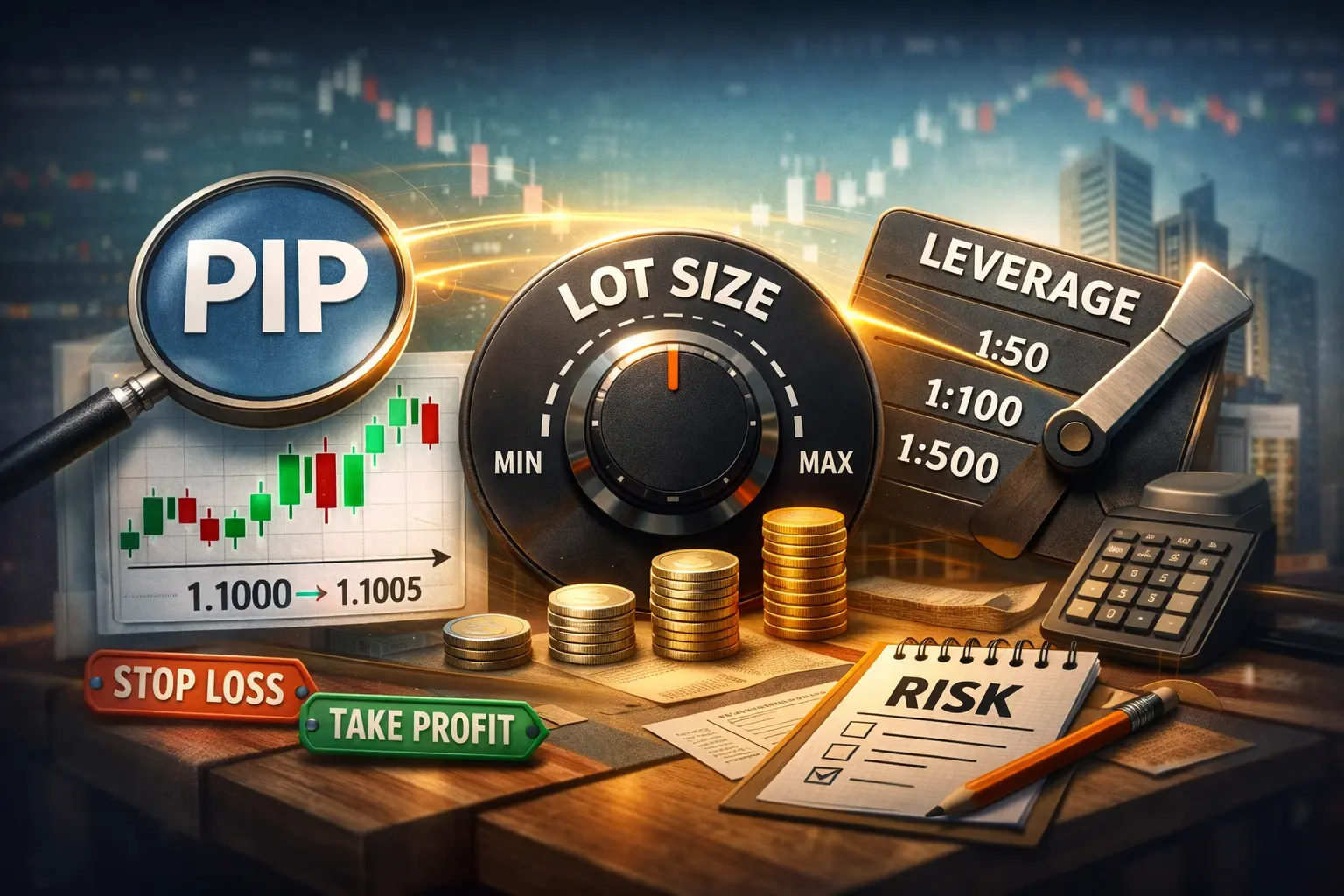
A pip is the smallest unit of price movement.
For most currency pairs:
For JPY pairs:
Example:
EUR/USD moves from 1.1050 → 1.1060
Movement = 10 pips
Pips are used to calculate:
- ✓ Profit
- ✓ Loss
- ✓ Stop Loss
- ✓ Take Profit
- ✓ Risk per trade
7. What is Lot Size in Forex? (Beginner Explanation)
Lot size determines how much money you earn per pip.
- ✓ 1.00 lot (Standard) → ~$10 per pip
- ✓ 0.10 lot (Mini) → ~$1 per pip
- ✓ 0.01 lot (Micro) → ~$0.10 per pip
Beginners should ALWAYS start with micro lots (0.01) until they fully understand risk management.
8. What is Leverage in Forex? (Simple Example)
Leverage allows you to control a large trade with a small amount of money.
Example:
With 1:100 leverage, your $100 controls $10,000 in the market.
Pros
- ✓ Start with small capital
- ✓ Make money even from small moves
Cons
- ✗ Losses multiply
- ✗ Beginners blow accounts with high leverage
This is why people ask: Is forex trading safe for beginners?
Yes — if leverage is low (1:10 or 1:20).
High leverage (1:500, 1:1000) is extremely risky.
9. What is Spread? (The Broker’s Fee)
Spread = the difference between:
- ✓ Buy price (Ask)
- ✓ Sell price (Bid)
Example:
Spread = 2 pips
This is why every trade starts slightly negative — the spread is the broker’s fee.
10. How Do Forex Traders Make Money? (Simple Explanation)
You make money by predicting whether a pair will move up or down.
- ✓ BUY (Long) — If you think price will rise.
- ✓ SELL (Short) — If you think price will fall.
Your earnings = pips gained × lot size
Example:
Buy EUR/USD at 1.1000
Close at 1.1020
Profit = 20 pips
If lot size = 0.10 → You earn ~$20.
Understanding this is essential before reading a full forex trading step-by-step guide.
11. Forex Trading Styles (Choose Based on Personality)
1. Scalping
- Trades last 1–5 minutes
- High speed, high focus
- ✗ Not recommended for beginners
2. Day Trading
- Trades close before the day ends
- ✓ Best for beginners
- ✓ Clear market structure
3. Swing Trading
- Trades last 1–3 days
- Requires patience
4. Position Trading
- Long-term trading
- For experienced traders
Beginners should stick to day trading.
12. What Moves the Forex Market?
Forex moves because of global events, such as:
- ✓ Employment reports (NFP)
- ✓ Inflation (CPI)
- ✓ Interest rate decisions
- ✓ Central bank announcements
- ✓ Political events
- ✓ Global crises
- ✓ Institutional orders
These events create both opportunities and risks.
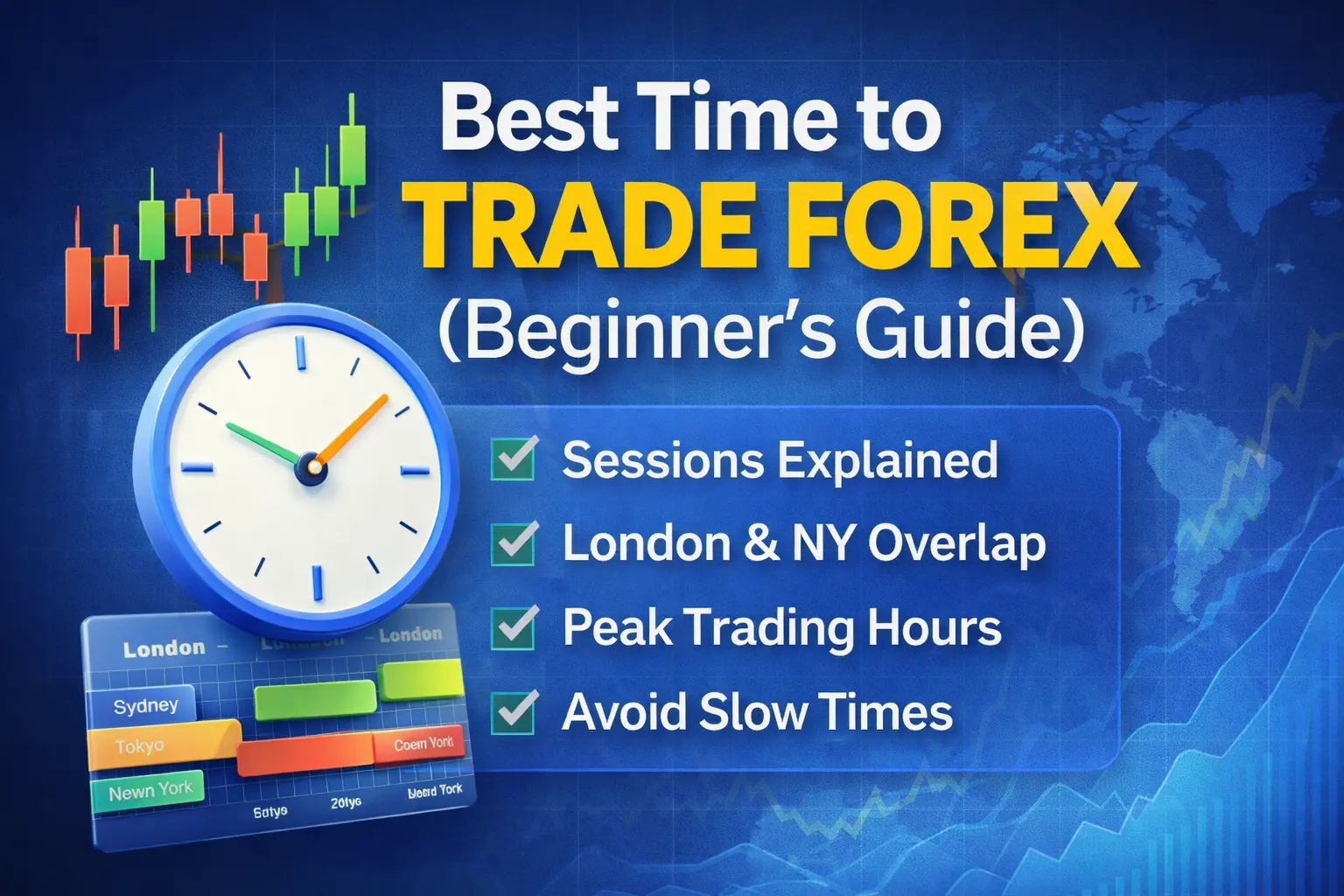
13. Forex Trading Sessions (Best Times to Trade)
best pairs to trade for beginners
Forex has four major trading sessions:
- ✓ Tokyo (Asian) — Slow
- ✓ London — Volatile, trending
- ✓ New York — Strong price moves
- ✓ London–NY Overlap — Most active
Best time for beginners:
- ✓ London session
- ✓ London–New York overlap
Beginner-friendly pairs during these times:
- ✓ EUR/USD
- ✓ GBP/USD
- ✓ USD/JPY
These are the best pairs to trade for beginners because they are stable, liquid, and predictable.
You need:
- ✓ Trading Platform — MetaTrader 4/5 or TradingView
- ✓ Broker Account — Choose a regulated broker
- ✓ Economic Calendar — Avoid trading during big news
- ✓ Risk calculator
- ✓ Position size calculator
- ✓ Trading journal
15. Is Forex Trading Safe for Beginners? (Real Answer)
Forex is safe IF you follow rules. It is dangerous if you don’t.
Forex is safe when:
- ✓ You risk 1% per trade
- ✓ You use a stop loss
- ✓ You trade micro lots
- ✓ You use low leverage
Forex is dangerous when:
- ✗ You gamble
- ✗ You overtrade
- ✗ You use high leverage
- ✗ You have no risk management
So, is forex trading safe for beginners?
→ Yes, only if you follow proper risk rules.
16. Common Mistakes Beginners Make (Avoid These)
- ✗ Trading without stop loss
- ✗ Using high leverage
- ✗ Trading during news
- ✗ Overtrading
- ✗ Using too many indicators
- ✗ No trading plan
- ✗ Emotional revenge trading
Avoiding these mistakes can save months of frustration.
17. How to Start Forex Trading for Beginners (Step-by-Step Guide)
Step 1: Learn the Basics
Understand:
- ✓ Pips
- ✓ Lots
- ✓ Leverage
- ✓ Sessions
- ✓ Currency pairs
Step 2: Choose a Regulated Broker
Look for:
- ✓ Tight spreads
- ✓ Low fees
- ✓ Fast withdrawals
- ✓ Good reviews
Step 3: Open a Demo Account
Practice for 30–60 days before trading real money.
Step 4: Learn One Strategy
Pick ONLY one:
- ✓ Price Action
- ✓ ICT
- ✓ SMC
- ✓ Trend following
Avoid jumping between strategies.
Step 5: Start with Micro Lots
- ✓ 0.01 lot
- ✓ 1% risk
- ✓ Low leverage
Step 6: Journal Every Trade
Write:
- ✓ Why you entered
- ✓ Why you exited
- ✓ What emotion you felt
- ✓ What you learned
This improves your trading more than any indicator.
18. Conclusion — Forex Trading Explained Simply
Forex trading is the process of predicting whether one currency will rise or fall against another. It is accessible, beginner-friendly, and ideal for small accounts.
If you’re learning how to start forex trading for beginners, focus on:
- ✓ Small lot sizes
- ✓ Low leverage
- ✓ One simple strategy
- ✓ Trading the best pairs to trade for beginners like EUR/USD
- ✓ Journaling every trade
With consistency, discipline, and patience, forex trading can become a powerful long-term skill and income source.
FAQ Section (SEO Optimized)
1. What is forex trading in simple words?
Buying one currency and selling another to profit from price movement.
2. How to start forex trading for beginners?
Learn basics → choose broker → open demo → practice → trade small lots → follow a forex trading step-by-step guide.
3. Is forex trading safe for beginners?
Yes, if you use small lots, low leverage, stop loss, and proper risk management.
4. What are the best pairs to trade for beginners?
EUR/USD, GBP/USD, and USD/JPY.
5. How much money do I need to start trading forex?
You can start with $50–$200, but practice on demo first.