Ultimate ICT Trading Glossary 2025 – 50+ Powerful Terms Every Trader Must Master
- Published On: 02/09/2025


Join Our Telegram Channel

Master the language of ICT trading! This ultimate ICT Trading Glossary explains 50+ key terms — from order blocks to fair value gaps — to help you trade smarter.
If you’ve been diving into ICT (Inner Circle Trader) or SMC (Smart Money Concepts), you’ve likely felt lost in a sea of new terms: OB, FVG, BOS, CHoCH… what do they even mean?
This glossary is your ultimate cheat sheet — designed for beginners, intermediate traders, and even seasoned pros looking to refresh their knowledge.
By the end of this guide, you’ll not only understand 50+ essential ICT & SMC terms but also know how to apply them directly to your charts.
Understanding market structure and price action is the backbone of ICT and SMC trading. Here are the essential terms you must master:
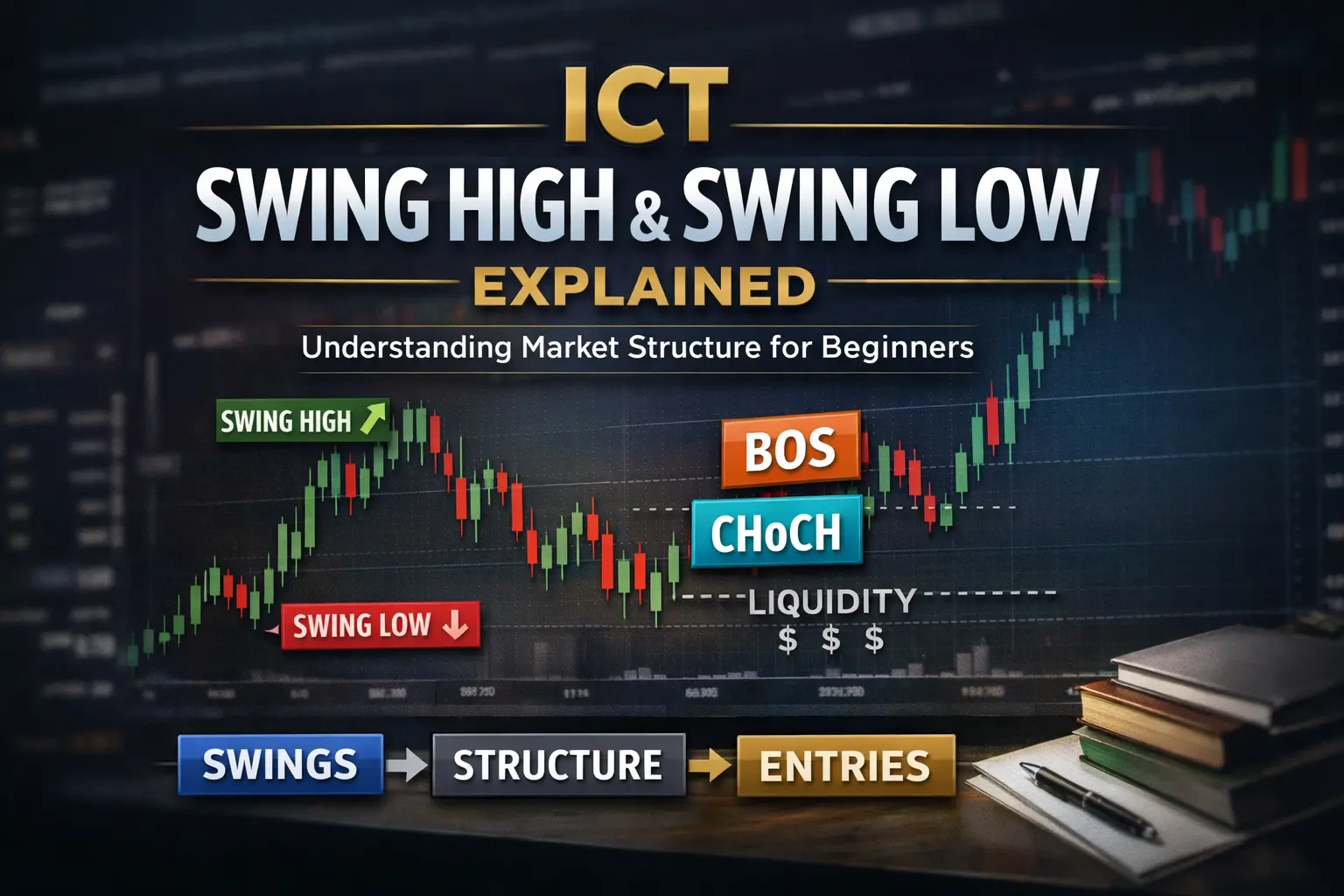
A confirmed shift in market structure, signaling that the existing trend is likely to continue. For example, a bullish BOS indicates buyers are still in control.
An early warning sign of a potential reversal. When the market breaks a minor level against the trend, it often hints that the direction may soon flip.
A more significant structural change compared to CHoCH — often the precursor to a major trend reversal or new trend formation.
These are the peaks and valleys on your chart. They act as liquidity magnets where traders place stop-losses — and where smart money loves to hunt!
Combining high timeframe (HTF) analysis (e.g., Daily, 4H) with low timeframe (LTF) execution (e.g., 15m, 5m). This top-down approach improves entry precision.
A level marked in advance — order block, fair value gap, or imbalance zone — where you expect price to react.
Think of price as a seesaw.
Retracement = temporary pullback (healthy correction).
Impulse = strong move in trend direction (institutional activity).
Learning to spot the difference prevents early exits.
A sideways market where price accumulates liquidity before a big move (often followed by a BOS).
A brief consolidation or pullback that forms before the trend resumes — like a pause before the next sprint.
Liquidity is the lifeblood of price movement in both ICT and SMC trading. Understanding how it works helps you trade with the smart money instead of against it.
A cluster of stop-losses or pending orders sitting at obvious highs or lows — prime hunting grounds for institutions.
A fake-out move designed to lure retail traders into the wrong direction before the true move begins.
A sharp, quick sweep above or below key levels to grab liquidity — wiping out stop-losses before price reverses.
Stop orders resting above recent highs, often targeted in bullish setups before the market moves down.
Stop orders sitting below recent lows, frequently taken out before price pushes higher.
These “perfect double tops/bottoms” are a retail trader trap — institutions love to sweep them because everyone thinks they’re safe levels.
A thin area on the chart with little to no trading — price often travels through these zones rapidly.
An intentional wick or spike designed to collect liquidity from both sides before the actual directional move.
The powerful price movement that follows after liquidity has been collected.
Phases where the market builds up liq
These are the core ICT and Smart Money Concepts tools that institutional traders use to engineer price movements. Understanding these tools gives traders an edge in Forex, Gold (XAUUSD), Indices, and Crypto.
An Order Block is the last opposing candle (bullish before a drop or bearish before a rise) where institutions place major orders. It forms the foundation of ICT and SMC setups and is often used to anticipate market reversals or continuations.
A Fair Value Gap is a price gap created when buyers and sellers fail to meet equally. In ICT trading, FVGs often act as magnets for price, predicting potential pullback or continuation zones.
A Breaker Block is a failed Order Block that flips its role—support becomes resistance or vice versa. Traders use Breaker Blocks for high-probability reversal setups.
This type of Order Block is used to mitigate or offset previous institutional positions before a new trend begins. It helps smart money rebalance its books.
An Imbalance is a zone where buy and sell orders were uneven, leaving a void in price. The market often revisits these zones to restore balance.
Refinement involves zooming into lower timeframes (LTF) to find more precise entries within a larger Order Block or FVG. It allows for tighter stop losses and better risk management.
A Volume Imbalance is an area with low trading participation, often indicating a potential sharp move in the future once liquidity returns.
An Institutional Candle is the candle that starts a significant impulsive move, marking the presence of institutional players entering the market.
Supply Zones represent high-sell areas, and Demand Zones mark high-buy areas. They form the backbone of SMC trading and are used to forecast price reactions.
Displacement refers to a strong impulsive move that clears liquidity and sets a new market direction. It is a common signature of institutional activity in both ICT and SMC trading.
Timing is everything in Smart Money and ICT trading. These models help traders identify when the market is most likely to move with institutional flow rather than random noise.
This session often delivers high-probability setups as European markets open and liquidity floods in.
The AM Killzone captures volatility from the NY open, while the PM Killzone (1–3 PM NY) is key for ICT’s Silver Bullet strategy.
A false move in the opposite direction before the true trend takes off, commonly seen during session opens.
The Asian session (Tokyo hours) often forms a tight range, which is later swept for liquidity in London or NY sessions.
A powerful model that explains how the market builds orders, sweeps liquidity, and finally moves in its intended direction.
An advanced ICT concept focusing on sniper entries during the NY PM session for quick, high-RR trades.
When two major sessions (London & NY) overlap, liquidity surges, creating strong trading opportunities.
Using higher timeframe analysis (daily/4H) to set a directional bias for the day, aligning trades with institutional flow.
Managing your risk is just as important as finding the perfect entry. Smart Money and ICT traders use precise methods to protect capital and grow accounts strategically.
The ratio between potential loss (risk) and potential gain (reward) that determines the quality of a trade setup.
Taking partial profits at predefined levels helps lock in gains while keeping a portion of the trade running for bigger moves.
The percentage loss from your peak account balance, crucial for long-term sustainability.
Fine-tuning your entry on lower timeframes to achieve tighter stop-losses and higher R:R setups.
Predetermined areas based on liquidity pools or market structure where profits are taken.
Distributing your capital and risk across trades to avoid overexposure.
Understanding how markets hunt obvious stop levels so you can set smarter, protected stops.
Keeping detailed records of your trades to review, analyze, and continuously improve your strategy.
Want to keep this handy?
[Coming Soon]
Mastering ICT and SMC isn’t about memorizing setups — it’s about understanding the language of smart money.
This glossary is your first step toward fluency. Keep it close, revise often, and soon, these terms will become second nature.


Why ICT Trading? Scope, Myths & Step-by-Step Smart Money Guide
January 24, 2026

Connect with focused ICT learners on our Telegram. Get daily insights, updates, and clear guidance to simplify your trading journey.
Join Channel