ICT Trading for Beginners: The Complete Step-By-Step Learning Hub (2026 Guide)
- Published On: 15/01/2026


Join Our Telegram Channel

ICT (Inner Circle Trader) is a smart money trading methodology that explains how professional institutions—banks, hedge funds, and algorithms—move the market. Instead of indicators and retail patterns, ICT focuses on price action, liquidity, timing, and market structure to understand why price moves and where it is likely to go next.
For beginners, ICT often feels confusing. Not because the concepts don’t work—but because most people learn them in the wrong order. They jump between videos, mix advanced ideas too early, or try to trade setups without understanding the bigger market narrative.
This leads to frustration, inconsistency, and doubt—even though the method itself is highly logical.
That’s where structure becomes everything.
ICT is not a single strategy. It’s a complete framework where each concept builds on the previous one: chart setup → time & sessions → market structure → liquidity → PD arrays → execution → management.
When learned out of sequence, it feels complex. When learned step by step, it becomes clear, repeatable, and powerful.
This guide is designed to be your central learning hub. Inside this page, you’ll find a clear, beginner-friendly roadmap that connects all major ICT concepts in the correct order.
Each section introduces a core idea and points you to deeper, detailed guides—so you always know what to study next and why it matters.
Whether you’re completely new to ICT or looking to organize your learning properly, this page is meant to be your starting point and reference base for the entire ICT journey.
ICT trading is a smart money approach that teaches traders how large financial institutions—such as banks, hedge funds, and market-making algorithms—actually move price in the financial markets. Instead of guessing entries or relying on indicators, ICT focuses on understanding institutional behavior and the logic behind price movements.
At its core, ICT is built on one key idea: the market moves to seek liquidity and deliver price efficiently, not to follow indicators or retail patterns.
Retail traders react to price after it moves. Smart money creates the move.
Institutions need liquidity to enter and exit large positions. To do that, price is often pushed toward areas where retail traders place stop losses—such as equal highs, equal lows, or obvious breakout levels. Once that liquidity is taken, the real move begins.
ICT teaches you how to:
This logic turns the market from something that feels random into something that follows a repeatable narrative.
ICT uses a set of concepts that institutions naturally operate around, including:
You don’t need to trade all of these at once. The goal is to understand how they connect and build a logical framework, not a collection of signals.
Most beginners start with indicators like RSI, MACD, moving averages, or oscillators. These tools are based on past price data, which means they always react late.
ICT is different because it:
This shift—from indicators to understanding market intent—is what makes ICT powerful when learned correctly.
ICT traders don’t enter trades randomly, and they don’t rely on signals or indicators. They read the market using a simple but powerful 3-step framework that explains what the market is doing, why it is doing it, and where price is likely to go next. This framework stays the same on every timeframe.
Market structure tells you the direction and condition of the market. ICT traders first ask whether the market is trending or ranging, whether highs are being broken or protected, and whether the narrative has changed or continued.
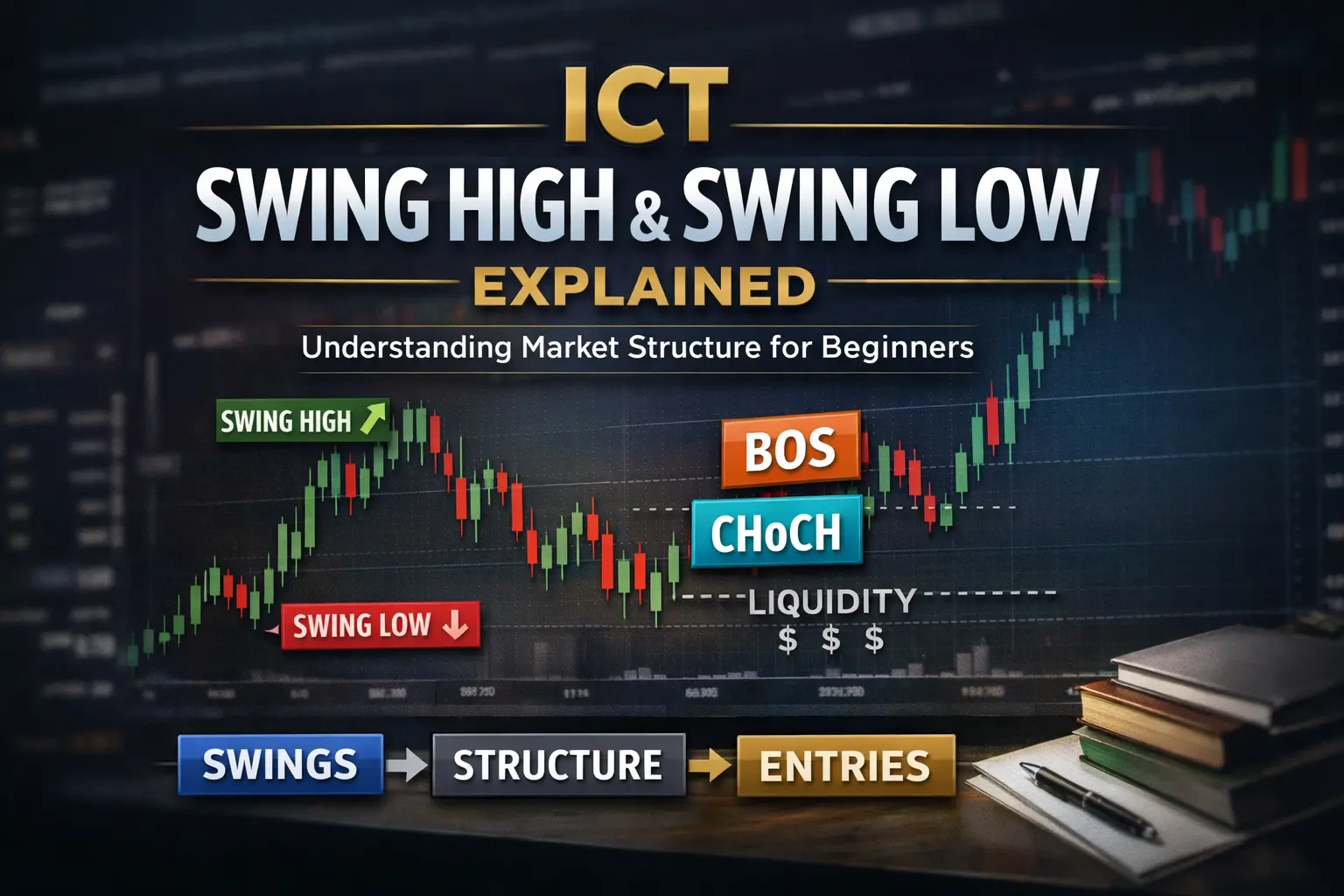
Structure is built using swing highs and swing lows, not indicators. These swings reveal whether institutions are pushing price higher, distributing positions, or preparing for a reversal. Without understanding structure, every setup becomes a guess.
Once structure is identified, ICT traders focus on liquidity. Institutions move price to collect stop losses, fill large orders, and rebalance inefficiencies.
Liquidity often sits above equal highs, below equal lows, and around obvious retail levels. Price is frequently drawn to these areas before making the real move.
This explains why breakouts often fail, price spikes suddenly and then reverses, and traders get stopped out right before the move. Liquidity provides the reason behind price movement.
PD Arrays (Premium & Discount Arrays) are institutional price zones where reactions are likely to occur. These include Fair Value Gaps (FVGs), Order Blocks, Premium & Discount levels, and Balanced Price Ranges.
After liquidity is taken and structure aligns, ICT traders wait for price to reach a PD Array before considering an entry. This creates patience, precision, and better risk-to-reward.
Most traders try to enter first and then explain later. ICT traders do the opposite. They read structure, identify liquidity, and wait for price to reach a PD Array.
This removes emotion and replaces it with logic and sequence. When you understand this framework, ICT stops feeling complex — it becomes systematic and repeatable.
One of the biggest reasons traders fail with ICT is not because the concepts don’t work — it’s because they learn them in the wrong order. ICT is a layered framework. Each concept depends on the previous one, and skipping steps creates confusion.
A proper ICT learning roadmap turns chaos into clarity. Below is the correct progression every beginner should follow.
Before thinking about entries, you must understand the trading environment. This phase focuses on:
At this stage, your goal is understanding, not trading frequently.
Once the foundation is clear, the next step is learning how price behaves. This phase includes:
This is where ICT starts to “click.” You stop guessing direction and start reading market intent.
Only after structure and liquidity make sense should you focus on entries. This phase covers:
Here, quality matters more than quantity. Fewer trades, better execution.
The final phase is what separates hobby traders from consistent ones. This phase focuses on:
At this level, trading becomes process-driven, not emotional.
ICT concepts are powerful only when stacked correctly. Learning entries before structure is like building a house without a foundation.
When you follow a clear roadmap:
Before learning market structure, liquidity, or entries, you must first set up your trading environment correctly. A poor chart setup creates confusion, missed context, and emotional decisions. ICT trading requires clarity before strategy. This step is not about adding indicators — it’s about removing noise.
ICT trading is based on price behavior, not signals. If your chart is cluttered with indicators, colors, and unnecessary tools, you’ll struggle to see:
A clean chart helps you read price the way institutions do.
To trade ICT properly, you only need a few essential tools:
That’s it. No oscillators. No indicators. No signal tools.
Your chart should prioritize readability:
The goal is to instantly understand where price is, not to decorate the chart.
ICT trading is highly time-sensitive. Knowing when you trade matters just as much as knowing what you trade. Your setup should help you easily recognize:
This prepares you for later concepts like killzones and session-based models.
At this stage, your focus should be:
Many beginners rush to place trades. ICT rewards those who first build observation and patience.
Before applying ICT concepts like structure, liquidity, or PD arrays, it’s important to understand the basic mechanics of the Forex market. ICT trading is not separate from Forex — it operates within it. When beginners skip this step, they often misunderstand risk, position size, and market movement.
You don’t need to become a Forex expert. You only need to understand the essentials that directly affect your trades.
Forex (foreign exchange) is the market where currencies are traded against each other. It’s the most liquid market in the world, which makes it ideal for institutional trading — and that’s exactly why ICT concepts work so well here.
ICT traders commonly focus on:
Understanding how Forex works helps you respect volatility, timing, and cost.
Every Forex trade is measured using:
Beginners often misuse leverage because they don’t understand how these three interact. ICT trading emphasizes controlled risk, not oversized positions.
The goal is simple:
Every trade includes costs such as:
These costs affect your results, especially if you overtrade or scalp without understanding execution quality. ICT traders aim for high-probability trades, not constant activity.
When you understand Forex basics:
ICT concepts become easier to apply because you’re no longer guessing how price movement translates into profit or loss.
In ICT trading, time is not optional — it’s a filter. Many beginners focus only on entries and patterns, but ICT teaches that when you trade is just as important as where you trade. The same setup can fail at the wrong time and work perfectly during the right session.
Understanding time removes randomness from your trading.
Institutions do not trade all day randomly. They operate during specific time windows when liquidity is highest and large orders can be executed efficiently. Outside these windows, the market is often slow, choppy, or misleading.
ICT traders use time to:
ICT trading revolves around three key sessions:
Each session has a different purpose in the daily market narrative. Understanding this prevents overtrading and poor entries.
Killzones are specific time windows inside the London and New York sessions where institutional activity is most concentrated.
This is when:
Instead of watching charts all day, ICT traders focus only on these windows.
Daily trades should never be random. ICT traders align intraday execution with a weekly bias, formed using:
This ensures you’re trading with the broader narrative, not against it.
Beginners who ignore time often experience:
Time gives context. Without it, even good setups fail.
Market structure is the foundation of all ICT analysis. Before thinking about entries, indicators, or confirmations, ICT traders first understand what price is doing structurally. Without structure, every setup becomes a guess.
Market structure answers one core question: Is the market continuing, or is it preparing to reverse?
ICT market structure is built using swing highs and swing lows, not moving averages or trendlines. These swings show where institutions defended price and where control changed.
By reading swings correctly, you can:
Random swings create false bias. Valid swings create clarity.
Not every break matters.
Most beginners treat every breakout the same. ICT traders differentiate between continuation and transition — and this single skill dramatically improves accuracy.
Structure alone is not enough. ICT traders look for displacement, a strong and impulsive price move that confirms institutional participation.
Displacement:
Weak price movement is often ignored. Strong displacement earns attention.
Markets don’t move randomly — they operate inside dealing ranges. Within a range, price oscillates between premium and discount areas while building liquidity.
ICT traders use dealing ranges to:
Knowing where price is inside the range is as important as knowing what it’s doing.
Many beginners fail because they look for entries before understanding structure. ICT flips this approach.
The correct order is:
When structure is clear, patience becomes easy.
Liquidity is the engine that drives price movement in ICT trading. Without liquidity, institutions cannot enter or exit large positions. This is why price often behaves in ways that confuse beginners—moving into obvious levels, triggering stops, and then reversing. Once you understand liquidity, the market starts to make sense.
In trading, liquidity refers to orders waiting in the market. For institutions, this means finding areas where many traders are likely to place stop losses or pending orders.
These areas commonly form around:
Price is often drawn to these levels because that’s where volume exists.
Large institutions can’t simply buy or sell at random prices. They need counter-orders to fill their positions. Liquidity provides that fuel.
This explains why:
What looks like manipulation is often order execution.
ICT separates liquidity into two types:
Price often moves from internal liquidity to external liquidity as part of a larger narrative. Understanding this helps traders avoid entering too early and improves timing.
Before the true move, price frequently creates inducement—a setup that encourages traders to enter in the wrong direction. Once enough traders are positioned, price sweeps liquidity and then delivers the real move.
This is why patience is critical in ICT trading.
When you understand liquidity:
Liquidity turns chaos into logic.
After structure and liquidity are understood, ICT traders focus on where price is most likely to react. This is where imbalances and PD Arrays come into play. They provide the location for entries, not the reason for entries.
ICT does not chase price. It waits for price to return to institutional inefficiencies.
An imbalance occurs when price moves so aggressively that not all orders are filled fairly. This creates inefficiency in the market, which price often revisits later to rebalance.
In ICT, the most common imbalance is the Fair Value Gap (FVG)—a three-candle price pattern that shows strong institutional displacement.
Imbalances tell you:
FVGs represent areas where price moved too fast to trade fairly. Markets naturally seek balance, which is why price often returns to these zones.
However, not every FVG is tradable. ICT traders look for FVGs that align with:
When aligned correctly, FVGs become high-probability reaction zones.
PD Arrays (Premium & Discount Arrays) are institutional reference points used to judge value. They include:
The key idea is simple: entries are taken only at logical locations, not in the middle of price.
PD Arrays help you wait for price to come to you, instead of chasing it.
Many beginners try to learn entries first. ICT reverses that approach.
The correct sequence is:
This sequence improves patience, accuracy, and risk-to-reward.
One of the biggest mistakes beginners make is trying to trade too many ICT models at once. ICT is powerful, but only when applied with simplicity and discipline. At the beginner stage, your goal is not to trade often — it is to trade correctly. A simple ICT setup helps you build confidence without overwhelming you.
A beginner-friendly ICT setup should meet three conditions:
This means avoiding complex combinations and focusing on one clean idea that repeats often.
A basic ICT setup usually follows this structure:
You are not predicting. You are waiting for confirmation.
New traders often believe more trades mean faster learning. In reality:
ICT rewards patience. Missing trades is part of the process.
At this stage:
Your job is to execute the same idea repeatedly, not to chase every move.
Risk management is not optional in ICT trading — it is the foundation that keeps you in the game long enough to succeed. Even the best ICT setup will fail sometimes. What separates consistent traders from blown accounts is how much they lose when they are wrong. ICT traders focus on survival first, profits second.
Many beginners search for a “high win-rate setup.” ICT teaches something more important: a trader with good risk can survive a bad strategy, but a trader with bad risk will destroy a good one.
Proper risk management allows you to:
ICT traders think in R-multiples, not money.
This mindset:
Instead of asking “How much money can I make?”, ICT traders ask, “How much am I willing to risk if I’m wrong?”
Leverage is a tool — not an advantage.
Beginners should:
Controlled position sizing protects you from emotional decisions and market noise.
Losses are part of trading. In ICT, a small, controlled loss means:
The goal is not to avoid losses — it is to avoid large losses.
At this stage:
Consistency comes from discipline, not confidence.
ICT trading is a skill, not a shortcut. And like any skill, it improves fastest through deliberate practice and review. Backtesting and journaling are the tools that turn knowledge into experience—without risking real money. This step is where most real progress happens.
ICT concepts work through repetition and pattern recognition. Backtesting allows you to:
Using replay mode, you can practice years of market behavior in weeks.
Beginners should not backtest everything. Focus on:
This keeps feedback clean and learning fast. Backtesting is not about finding perfection — it’s about building familiarity.
Most traders lose not because of bad setups, but because they repeat the same mistakes. Journaling makes those mistakes visible.
A good ICT journal tracks:
This transforms random results into actionable insight.
Winning trades feel good, but losing trades teach more. Weekly reviews help you:
Over time, your journal becomes a personal trading manual.
You don’t need to backtest for hours every day. Even 30–60 minutes consistently produces better results than occasional long sessions. ICT rewards those who show up daily.
ICT trading becomes simple when you follow a process instead of emotions. This checklist is designed to help you stay consistent, avoid common beginner mistakes, and focus only on what matters. Use this before every trading session.
Before opening any trade, confirm:
If even one item is missing, you wait.
At the start of each week:
This prevents overtrading and emotional decision-making.
Most beginners fail not because ICT doesn’t work, but because they:
Avoiding these mistakes alone puts you ahead of most traders.
You’re ready to explore advanced ICT topics only when:
Progress comes from discipline, not speed.
You now understand the core foundation of ICT trading. The next step is to deepen your knowledge in the areas that matter most, based on where you are in your learning journey.
Choose the section that fits your current focus:
➡️ Market Structure
(Coming Soon)
Dive deeper into swing structure, BOS vs CHoCH, liquidity, narrative building, and how institutions move price.
➡️ Advanced ICT Concepts
(Coming Soon)
Explore Fair Value Gaps, Order Blocks, PD Arrays, entry models, and professional trade management techniques.
➡️ Sessions & Timing
(Coming Soon)
Learn how time controls market behavior, including killzones, session models, and high-probability trading windows.
➡️ Forex Basics
Strengthen your foundation with clear explanations of pips, lot size, leverage, spreads, and execution costs.


Why ICT Trading? Scope, Myths & Step-by-Step Smart Money Guide
January 24, 2026

Connect with focused ICT learners on our Telegram. Get daily insights, updates, and clear guidance to simplify your trading journey.
Join Channel